Class Review – February 2018

This year, one of the things I wanted to do is try new things in the fitness world.  I am always reading and researching and learning from the other therapists and trainers at my studio.  I also try to soak up as much knowledge as I can when talking to the great practitioners in my network, but I haven’t actually been out there to try what the other guys are doing in a while.

So I have committed to trying something new each month and to write a review about it.  By no means do I pretend that these are objective reviews.  Think of this as more my opinion as a fitness expert (it does say opinionated fitness guru in the title).  Also, there may be things I don’t like that you do.  I am not here to debate, just stating my thoughts because my name is in the url.

Orangetheory Fitness®

I must admit, OTF (that’s what the regulars call it) was on the top of my list of classes to try.  I love High Intensity Interval Training (HIIT), especially in a group setting where you all get to suffer together.  I am also a fan of the simplicity of something like OTF and appreciate how much this place has their business dialed.

From the moment I booked the appointment online, I was amazed at the efficiency of OTF’s system.  Booking a free class online was super easy.  Immediately after I booked, I received a confirmation email with all the regular rules and regulations the go along with appointments, but it also had detailed information about what to expect.  It let me know location, where to park, what time to arrive, what would happen when I arrived, how the class was laid out, etc.  Very helpful for a first-timer.

The day of the class, I arrived the 25 minutes early they suggested.  I was greeted at the door with a cute, welcome sign with my name and the 4 names of the other first-timers on it.  One of the ladies at the desk took me on a tour, showed me where I could store my stuff, gave me a heart-rate monitor, help set up my station, and watched my rowing form.  By the time class started, I felt pretty comfortable.

Class is set up in 3 blocks – rowing, treadmill or spin bike, and weights.  You spend about 20 minutes at each station and run through 2 sets of intervals.  I started on the rower and the coach incorporated distance sprints with reps of a squat and press for our first interval and then timed sprints for the 2nd interval set.  The treadmill station used incline and speed against time for the intervals, and the weight section went through 2 different weight routines.

The cool thing about class, is that you are at the same number station as you move about.  I was station 1, which meant station 2 was always to my left.  This was great because, as it turns out, station number 2 lady was super nice, an OTF regular, and super helpful if I got a little lost with what was going on in the class.  It was kind of nice to travel from station-to-station with a new friend next to you.

The whole story behind the “Orange” in Orange Theory is that they want you to get at least 12 or more minutes in the “Orange” or “Red” heart-rate zones.  These zones represent a heart-rate 85% or higher of your max heart-rate.  They calculate max heart-rate by subtracting your current age from 220.

Throughout the class, the coach came over 4 or 5 times to make sure I was getting along ok.  Throughout class, your heart-rate, zone, and time spent in the “Orange” and “Red” zones are all displayed on a screen under your name.  It is sort of fun because you can have a friendly competition with the others in the class.  Class was energetic and went by pretty quickly.  After class, the coach took the time to go over my heart-rate and explain what each of the numbers meant.
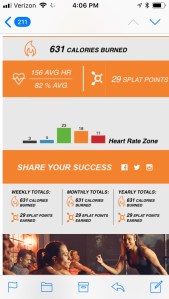
After I left the studio, I was sent an email with my stats from class (see right) and more information about membership.  Again, the process was so dialed-in and efficient.

Summary  

Cons:  Using a calculation of 220 minus your age to establish your max heart-rate is the easiest and fastest way, but definitely not the most precise.  I understand why they do it this way as it takes no equipment and could be calculated by a 3rd grader, but it could mislead people into thinking they are working harder or easier than they really are.  I spent 35 minutes in the “Orange” and “Red” zones and class was a workout, but definitely not a “killer”.  T

The weights section of the class was creative, but not super challenging.  It was hard to get my heart-rate high during this part and I didn’t feel like I got a whole lot out of it.  However, keep in mind, I do lift on my own 3-4 times a week.

Pros: As I stated above, they have their system dialed.  It is so smooth, so beginner-friendly, and so professional.  Even the workout was organized and methodical (and if you know me, this is a HUGE plus in my world).  I also like that they use common exercises like running/walking and rowing to do most of the intervals.  The simplicity allows for people to find good form and adjust as needed.

The staff was friendly, helpful, and always checking in on me.  Before class, during, and after I was never standing around feeling lost.  Someone always had their eye on me to make sure I knew where to go or what to do.  The studio was well-designed and organized, they kept it cool and had good air movement, and the music was pumping.

Resolution Reboot – A Plan for Success

So how are those New Year’s Resolutions going?  If your answer is “not so great”, you are not alone.  80% of people have given up on their resolutions by February.  But don’t worry, this is not failure, just a temporary set-back.  It is also not an excuse for YOU to give up.  With a little organization, re-motivation, and of course, a PLAN you can continue to work towards your goals.  Let’s get you back on track.

Grab a pen and paper and play along with me.

Identify Priorities

The first thing we need to do is establish your priorities in life.  What things are most important?  Where do you want to put your focus?  A lot of people come up with resolutions that do not coincide.  Establishing a connection between your goals and resolutions with your priorities in life will give you a much better success rate.

Answer these questions:

Who are the most important people in your life?

What are the biggest things you want to accomplish in this lifetime (you can be vague)?

How much time do you want to spend on yourself versus on/with others?

Looking at 2018, what do you want to accomplish over the next 10 months?

Identify your “Why”

Now that you have your priorities established, it is time dig into why you made your New Year’s Resolutions.  Knowing the root of your motivation to change will help carry you through the tougher points of your transition.  It will also help you identify if your goals truly represent what you want.  Establishing your “why” can help you modify your goals so they reflect what YOU want for YOURSELF rather than what you think the world wants of you.

Answer these questions:

How will your life be different when you accomplish your goal?

Who will benefit from you accomplishing your goal?  Yourself, family, work?

What will you lose out on or miss if you fail or give up?

What areas of your life will improve when you reach your goal?

Is your goal a final destination or a step in a larger process?

How will you feel once you accomplish your goal?

Why did you choose to change this year?

Make REAL Goals

With your “Why” established, you can now make real goals that fit with your life.  At this time, it is also important to recognize if you need to adjust your goals to match your life and priorities.

Answer these questions:

What is your goal for 2018?

What are 2 or 3 smaller goals that would help you move towards your 2018 goal?

Can you imagine yourself accomplishing this goal?

Is there anything you need to do to prepare or before you start working towards your goal?

Make a Plan

Now you have real goals, that fit within your lifestyle, and your “why” to keep you motivated.  All that is left, is a solid plan.  Success is not solely based on discipline and hard-work.  Trying to make major change without a plan is like running a race without knowing the route.  You can go as fast as you can, hour upon hour, and never reach the finish line.

Answer these questions:

What can you do TODAY to work towards your goal?

What obstacles are there to accomplishing your goal?

What are 2-3 solutions you can think of to help you overcome your obstacles?

What can you do on a daily basis to help you reach your goal?

What can you get done in the next 2 weeks to work towards that goal?

What can you plan now, to help you work towards your goal in the next 3-6 months?

What are good indicators that you have accomplished half of your overall goal?

Change is hard, but it is much easier when you know why you are changing and have a clear road map.  Do some work up front so you don’t find yourself struggling later down the line.  As Antoine de Saint-Exupéry stated, “A goal without a plan, is just a wish”.

Getting Started – High Intensity Interval Training

If you work out, know people who work out, or ever read anything on the internet about working out, you have probably heard of High Intensity Interval Training or HIIT. I know, it sounds “Intense” for lack of a better word.  Sounds like something crazy bootcamp people would do, or a high school football team, or celebrities.  But I am here to tell you ANYONE can do HIIT and EVERYONE can benefit from it.
The basic application of HIIT is to push yourself into an uncomfortable range during your cardio exercises and then fully recover, and then repeat for a certain amount of time.  That’s it.  That’s the magic equation.

Of course if you really start to dive into it, there is research on heart zones and RPE’s, and on time on vs. time off, and which intervals are better for weight loss and which ones are better to build endurance.  There is so much info on HIIT, that it can be overwhelming and keep you from just trying it and reaping the benefits.  Read below for the great benefits of HIIT and some “starter” workouts to get you going and on your way.

Benefits:

  • You’ll Burn More Calories – Not only do you burn calories while you are performing your HIIT workout, but that burn will stay with you for up to 2 hours after your finish your workout.  That means you can do your workout, shower, and head to work and still be getting a high calorie burn.
  • Great for your Heart – Due to its high demand on your blood vessels, HIIT can increase the flexibility and the elasticity of your arteries and veins.
  • Adaptable – You can do an HIIT workout on the treadmill, during a hike, in the middle of a bike ride, in a pool, everywhere and any movement can be turned into an HIIT session.
  • Reduces Blood Sugar Levels – After just 2 weeks of HIIT, one study found that there was an increase of glucose metabolism in the muscles, bringing sugar levels back to normal.
  • Saves You Time – Because you are working harder, you don’t have to work for very long.  You can get most of the same benefits in 15 minutes of HIIT session that you can get in 1 hour of jogging according to a 2013 study.
  • More Weight Loss – According to one study of persons with Type 2 diabetes, HIIT training has a bigger affect on weight loss than steady cardio.
  • Increased VO2 max – This means your body can utilize oxygen better during intense exercise.  You will be able to work harder and harder, but it will start to feel easier.
  • Increased Endurance and Stamina – Just 1 minute of high intensity work can improve your endurance.  The benefits of your quick HIIT workout will carry over to your next big hike, bike ride, run.
  • Reduces Liver Fat – According to a 2015 study, HIIT can help reduce the fat surrounding your liver by up to 16% in just 12 weeks of training.

The bottom line is…If you are not doing HIIT…START.

Here are a 3 HIIT workouts for the beginner/intermediate athlete (and by athlete, I mean you, not Tom Brady).

Walker’s Delight Routine

  • 0-5 Minutes – Walk at Regular Pace.
  • 30 seconds High Intensity – Uphill walking, quicker pace, skipping, big arm swings, anything that gets you heart pumping really nice.
  • 1.5 minutes Low Intensity – Regular walking pace or slower, dynamic stretching, backwards walking.  Just don’t stop moving.
  • Repeat Step 2 and 3 for a minimum of 10 minutes or a maximum of 20 minutes.
  • Last 5 minutes – Walk slow or stop and stretch to cool down.

Rainy Day Treadmill Routine

  • 0-5 minutes – Warm up with brisk walking or slow jog.
  • 45 seconds High Intensity – Increase the incline or speed to get your heart pumping.
  • 2 minutes Low Intensity – Back to your brisk walking or slower jog.
  • Repeat Step 2 and 3 for 6 circuits.
  • Walk slow for the last 3-5 minutes.

New Runner Neighborhood Blitz

  • 0-5 minutes – Warm up by walking a 2×1 block circle around a neighborhood (2 block straightaway to a right turn to a 1 block straightaway to a right turn to another 2 blocks, followed by a right turn to  1 block to bring you back to the beginning of your circle.)
  • 5-10 minutes – Walk the 2 block straightaway, run the 1 block straightaway.
  • 10-15 minutes – Run the 2 block straightaway, walk the 1 block straightaway.
  • 15-16 minutes – walk
  • 16-18 minutes – run
  • 18 – 20 minutes – walk
  • End at 20 minutes or repeat steps 2 and 3 to make it a full 30-minute workout.

Apply to Intern with Brenna Backe

Brenna Backe is the Owner of Koa Fit Personal Training Studio in Boulder, CO and has been in the field of personal training and coaching for the last 20 years.   Koa Fit just celebrated 5 successful years in business and Brenna is looking for an intern. Brenna’s unique training method has helped hundreds of clients who struggle with chronic aches and pains or had simply “given up”, get back in shape. She helps her clients build strength, lose weight, develop better body awareness and coordination, while decreasing the wear and tear on their bodies.

The current fitness arena is filled with Cross Fits, bootcamps, and high intensity interval training. There is a need for a more balanced workout. Brenna has been creating this missing link in fitness for the past 9 years at her 2 studios (previously sold her first studio, Active Fitness Solutions in NJ) and has been so successful she is looking for someone to train with her and help her at her studio.

If you are looking to develop a more specific and targeted form of training, Brenna would be interested in hearing from you.   She is looking for someone to start as an intern and then move into a personal trainer role at Koa Fit. Internship benefits are listed below.

This is the pilot of Brenna’s internship program. Due to that, she is not charging. Instead, she is exchanging 2 hours per week of admin/gym time at Koa Fit for the 8 weeks during the internship program.

Internship Includes:

  • Education Material
  • Assessment Tools and Guidelines
  • Exercise Protocols for special populations from Elite Athletes to Older Adults
  • One-on-One Trainings with Brenna
  • Opportunity to Shadow Brenna with Clients
  • Opportunity to take on paid training sessions

“If you have a strong understanding of the human body and a passion to learn more, and to teach to others, an internship at Koa Fit is ideal. Brenna is a perfect meshing of clarity and depth. She will strengthen your abilities to set a client on a clear path for growth. Brenna’s eye for detail on each individual, as well as her business strategy is something incredible to witness and absorb. Be prepared to be flexible with your time and welcomed warmly to the Koa Fit family.” – Rebecca, Koa Fit Trainer (Former Intern)

For more information or to apply, please fill out the information below.

Application Deadline is June 31, 2018

← Back

Thank you for your response. ✨

Podcast, Episode 2 – Work, Life and HEALTH Balance

Brenna Backe sits down with Missy Hughes and Siri Schubert-Nicollela to talk about work, life, and, health balance.  Working in the health and fitness industry, these 3 ladies cannot let their health and fitness slide.  Listen below for their top tips to keep and stay healthy, the one thing they could not live with out, and what happens when they get off track.

Strong and Balanced – Breathe Deep

Yes, this is yet another blog post about how important it is for us to breathe.  Why? Because we forget.  We do breathing exercises for a few days, maybe a couple of weeks, and then what happens?  Life, stress, and our daily grind get in our way.  So consider this your public service announcement for breathing for good health.

Now, I know you are busy, so I will get straight to the point.  Doing some form of breathing exercise can help you with the following:

  • Stress Reduction
  • Proper Organ Function
  • Decreased Inflammation
  • Better Sleep
  • More Endurance, Stamina, and Energy
  • Increased Flexibility, Tension Relief
  • Reduced Spinal Pain, Better Posture
  • Better Brain Function, Clarity
  • Decreased Anger
  • Strengthen the Immune System
  • Promote Good Digestion
  • Strengthens the Heart

You get the point, right?  It is one of the best things you can do for your well-being.

So, let’s get practicing.  Below is a video from my friend and amazing body-worker and life-coach, Emily Wishall.  In this video she goes over a few different ways to use your breathe to help you achieve your goals.  Whether you are trying to fall asleep or trying to gain some more energy in the afternoon, this 10-minute videos goes over simple exercises you can start incorporating into your daily life.

Also, check out Emily’s 10 Simple Steps to Jumpstart Your Day.

Happy Breathing!

Strong and Balanced – Community

When I opened my 2nd personal training studio in 2012, I wanted to build something larger than just a gym.  I really wanted to establish a place of community.  I wanted to be an informational resource for our town, to provide a space for people with common goals to come together and support each other, and I wanted to create a learning environment for the other trainers in the studio.  5 years later, there is definitely a strong community at Koa Fit AND it is something that I try to foster, care for, and grow every week I am in business.

Community = COMMON Purpose + Values + Experiences

Being part of a community, whether you seek it out or it finds you, is one of the most important pieces to living a strong and balanced life.  There are the communities we attach ourselves to because we have a common interest or purpose (think sports teams, weight loss groups, networking, etc) and then there are those we are part of because we share common values (non-profits, religion, political groups, etc.).  And then there are the communities we may just find ourselves in due to our life experiences (support groups, travel, neighborhoods, etc.).  You have probably found yourself in at least one or all 3 of these communities at one point or another in your life.  Being part of a community allows us to have a sense of belonging, provide mutual support, and have greater influence in our society.  It is important for us to not only be part of a community, but to be ACTIVE  and INVOLVED  in that community on a daily basis.

Support

One of the biggest benefits of being active in a community is the support that you get and give.  Working together, supporting each other through life’s challenges not only helps you bare the burden, but also fulfills the want to be needed as you help others.  As you give assistance to someone, you expand your capacity to be compassionate, patient, and generous.  You will also experience more in your life as you look at situations from someone elses shoes or help them get through a particularly trying time.  Your reality and view of the world can be expanded when you support those around you.

Understanding

As you engage and support people as a community, you will also better understand others.  You will understand where they came from, what they value, why they made certain decisions, and what they want to do in their life.  These insights into people’s lives create an atmosphere of understanding, so that even if we disagree, we can UNDERSTAND the other person’s viewpoint.   Understanding leads to patience which leads to compassion which then leads to trust.

This understanding also expands our own knowledge and gives us the opportunity to teach others.  This give and take is a much more valuable life education than anything we can pick up in a book or a classroom.

Connection and Trust

The biggest reason people join a community is to make connections.  It could be as simple as you all enjoy reading books or riding bikes, or it could be more complicated, like trying to conquer an addiction.  Whatever the reason, connection is something every human requires.  Connection leads to friendship and intimacy, and gives us the sense that we are on a team and that people have our backs.

These connections that we make in our communities also lead us to trusting one another.  It helps create a camaraderie in our society that allows us to walk down the street feeling safe and secure.  The more people you can connect with, build a relationship, and ultimately trust in your community, the more peace we can have in this world.

Move the World

Communities can create movements.  Obviously, as a group you have much greater influence than you do alone.  But bigger than that, the power a community can cultivate is exponential.  The motivation and inspiration that feeds the community is only doubled and tripled as the group expands.  This is literally the “power” of a community.  Giving your attention to something larger than yourself can help move attitudes, beliefs, and policy.